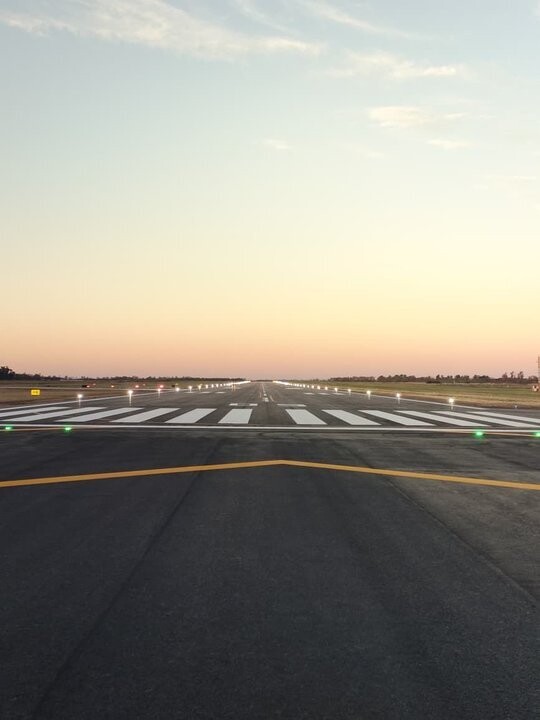
President Javier Milei headed the ceremony for the presentation of the first six F-16 combat aircraft incorporated into the Argentine Air Force, an investment that the Government considers strategic to reinforce the country's defensive capacity. The event took place in the city of Río Cuarto, in the province of Córdoba.
During his speech, the head of state affirmed that the arrival of the fleet marks a "historic day for all Argentines" and pointed out that this new stage in defense seeks to reverse decades of "neglect" towards the Armed Forces, according to the message released at the official event.
The President highlighted the aerial demonstration performed by the pilots from Río Cuarto to the Casa Rosada and their return to the base, an operation that allowed "hundreds of thousands of Argentines to look up and see their guardian angels crossing the sky for the first time".
He assured that the F-16s will now become "the new guardians of Argentine airspace" and emphasized that their incorporation increases the level of security for the entire population.
In his message, Milei stated that previous governments "left the country defenseless" and linked this situation to decisions motivated by partisan interests. "Today more than ever we can say that the forces of the sky are accompanying us," the President expressed when closing the event.
According to the Argentine News Agency, the ceremony at the Río Cuarto air base brought together defense officials, military authorities, and technical teams involved in the process of incorporating the new fleet, which represents one of the most significant operational movements in recent years for military aviation.
The Government plans to advance in new stages of the program during 2025, while the training of pilots and specialized personnel continues.
In the final part of his speech, Milei defined the F-16s as "a symbol of the Argentina we are building," a country that intends to regain its international prominence. He affirmed that his administration aims to "put the defense of the Fatherland in the place it deserves," with a strategy sustained in the reconstruction of the country's military capabilities.
In this context, he especially thanked former Minister Luis Petri, responsible for the purchase of the F-16s, who left his post to take a seat in the Chamber of Deputies. The President confirmed that the Ministry of Defense will be in the hands of Lieutenant General Carlos Alberto Presti, whom he described as a military man with a solid career and institutional values.
The head of state questioned the criticisms from opposition sectors regarding the appointment of the new minister. He considered that part of the public debate responds to an "infantile" position and accused Kirchnerism of promoting a process of "demonization" of the Armed Forces for twenty years.
According to Milei, the historical interpretation used by that political space sought to "obtain partisan gain" and eroded the link between military institutions and society. The head of state stated that the sovereignty vision of his critics is reduced to "a large shantytown decorated with pennants," while his administration seeks to rebuild wealth and the tools necessary to protect it.
In contrast, he defended that the choice of Presti is based on "technical and moral suitability" to lead the defense area. Milei also proposed to resume a discussion on the concept of sovereignty, stating that no country can aspire to sustainable development without a strong economy and military capabilities capable of deterring threats in an "uncertain" global context.